
Contract QA CVs for Medical Device Professionals
How Medical Device QA Professionals Should Rewrite Their CV for Contract Work
Medical device employers do not read a CV the same way for every role. A contract role gets read differently to a permanent one. A permanent hire is a long-term buy. The employer wants someone who will grow into the culture. Because of this, they want someone who will sit on committees and one day manage a team. A contract hire is different. Instead, the client needs one thing: a named deliverable, closed within a fixed number of weeks. That might be a corrective action backlog. It might also be a supplier audit programme. Or it might be a regulatory transition project.
This shift is not abstract. On 2 February 2026, FDA’s Quality Management System Regulation (QMSR) came into force, superseding the legacy Quality System Regulation (21 CFR Part 820) and incorporating ISO 13485:2016 by reference as the harmonised US quality standard. For manufacturers selling into the US market, this isn’t a paperwork update – it’s a structural realignment of design controls, CAPA, management responsibility, and risk management processes against a new regulatory baseline.
What’s needed now is talent who can perform a rigorous gap analysis between legacy QSR-based systems and ISO 13485:2016 requirements, remediate deficiencies against a hard compliance clock, and stand behind that work under FDA inspection scrutiny. That’s a narrow, high-stakes skill set with an unforgiving timeline – exactly the profile that favours contract engagement over a slower permanent search cycle.
Perhaps you have spent your career in permanent quality assurance roles in medical devices. If so, your CV was built for a different audience. Specifically, think about the habits that made you a strong permanent hire. Patient stakeholder management, committee involvement, and team development are not what a contract hiring manager scans for. Here is how to adjust your CV, and here is why the shift pays off.
What a contract hiring manager actually scans for
A permanent CV builds a career story. Instead, a contract CV should read like a project portfolio. Typically, most contract recruiters scan a CV in under a minute. First, they look for named deliverables. Next, they look for named standards. Then, they look for named systems. In short, they are checking whether you have done this exact piece of work before. They are not checking whether you have grown as a leader over ten years.
Because of this, it changes how you should present each role. Instead of describing your slow progression through a company, describe each engagement as a project. Do the same for each distinct phase of a role. Give it a scope. Then give it a duration. Finally, give it an outcome. Also, add your availability and notice period near the top of the page. This matters because a contract client wants to know when you can start before they read anything else.
The specific changes to make
The table below sets out the practical rewrites. First, it shows what a permanent quality assurance CV usually says. Then, it shows what a contract-ready version should say instead. Finally, it explains why each change matters to the person reviewing it.
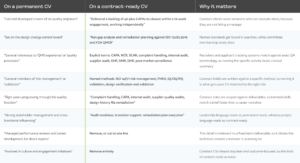
One more addition helps. Add a one-line summary at the top of each role. State the sector, the duration, and the core objective. This way, a hiring manager sees your result first. Then they can read the detail underneath it.
Why quality assurance professionals are moving into contracting
Contracting is not just a fallback between permanent roles. Instead, the wider labour market has been shifting towards independent, project-based work for some time. McKinsey’s American Opportunity Survey found that 36 percent of employed respondents identified as independent workers. That figure was 27 percent in 2016. Similarly, quality assurance in medical devices is following the same path. Regulatory deadlines create short, well-paid bursts of specialist demand.
For an experienced quality professional, contracting brings real variety. You move between different quality systems. You also move between different product classes, rather than mastering one company’s way of doing things. Meanwhile, day rates for scarce compliance skills often beat the pro-rata value of a permanent salary. This is especially true around audit readiness and regulatory transitions. You also choose which engagements interest you, rather than waiting for one employer’s next project to land. Because contract work gets judged on delivery, not on internal politics or long-term progression, many quality professionals prefer it. It is a more direct route to using their skills.
That said, contracting will not suit everyone. Moving between engagements means living with less certainty than a permanent post offers. But for quality professionals with strong technical depth and a clear record of delivery, it is an increasingly viable route. For many, it is also a more rewarding one.
If you are weighing up a move from a permanent quality assurance role into contracting, get in touch with the Skills Alliance Staffing team. We work across the medical device sector every day. So we can talk you through how your CV, and your expectations, should shift for the contract market.
By Alanna Holmes, Senior Consultant, Skills Alliance


